Reliably exchanging data has always been a critical component of businesses. Nowadays, data transactions are optimized and happen almost instantaneously, thanks to advances in technology and exchange methods. One of these methods is EDI, used by over a hundred thousand businesses across industries and countries.
In this article, we'll explain what EDI is, why it was developed, and some common use cases and industries that use EDI today.
What does EDI stand for?
EDI stands for Electronic Data Interchange. It is a type of computer-to-computer data exchange for business documents. Both the term itself and the definition are quite vague--data exchanging "electronically" happens in many forms after all, as do "business documents".
What sets EDI apart is that it is a set of standards used for specific documents and processes. Some common documents are purchase orders, invoices, and shipping manifests. Previously, these documents still existed, but they existed only in paper form. Naturally, this meant there was a significant delay for receiving and confirming documents. In fact, if you take Couchdrop's Christchurch, NZ location as one point and the United States as another, it wouldn't be uncommon for it to take weeks to arrive!
With companies expanding their reach all around the world, they needed a better solution, and EDI was developed to optimize data exchange between trading partners.
Why was EDI developed?
It became clear that the paper-based exchange of documents wasn't going to be feasible long-term if companies wanted to expand and operate internationally. Paper documents had several drawbacks in fast-paced industries, such as:
- Slow speeds. Sending documents by post could take days or even weeks.
- High cost. Paper documents needed to be printed, packed, and shipped. This cost adds up quickly when trading partners are overseas.
- Prone to errors. A human needed to manually check and validate documents.
- Security concerns. Paper documents could be easily lost or misplaced, and if intercepted, there was no way to know who had them or what they could use them for.
- Different interpretations. Trading partners could be using different terms or requirements for the same thing, meaning the two had to regularly translate the meanings of specific items.
An electronic data interchange system could solve all of these issues by being in a standardized format and having documents sent and processed directly by computers, removing the human element completely.
The problem was that in the 1960s and 1970s, there wasn't the infrastructure in place to easily send documents electronically.
Solving EDI without the internet
Today, sending documents anywhere in the world is simple. They can even be securely uploaded and downloaded from someone tens of thousands of miles away in seconds. But in the 1960s and 70s, this was a new challenge that needed to be overcome.
The World Wide Web wasn't invented until 1989, and wasn't adopted for public use until years later. While the internet as we know it today didn't exist at the time, networks themselves did, albeit in a limited form.
So how was this dealt with in the pre-internet days?
Originally, businesses connected using technologies like dial-up modems to send data over phone lines. Over time, one of the most common solutions became the use of a Value-Added Network (VAN), a privately-hosted network used as a hub for exchanging data with trading partners. To simplify, VANs act a bit like digital mailboxes, where messages are sent and then distributed to the correct end user.
VANs became an essential part of EDI. Eventually, alternative methods became available that made EDI more accessible to different businesses with different resources and requirements, and now there are many modern options to choose from.
Modern transfer methods for EDI
VANs are still used today, but are no longer ubiquitous for EDI thanks to more modern solutions and networking options. Instead of having to pass through a VAN, EDI documents can be now be sent directly between trading partners using protocols like SFTP or AS2.
Many cloud-first businesses now have files delivered directly to a cloud storage platform like Amazon S3, or Azure Blob using a modern file transfer platform to bridge the gaps between different platforms and protocols. The process can also be completely automated in some cases.
What do EDI documents look like?
Because EDI was designed for efficiency for computer-to-computer transmission, they don't need to be human-readable. To most people, EDI-formatted documents will look like a jumble of letters, numbers, and symbols, but they can be parsed by computers almost instantly.
Here's an example of an EDI 4010 856 Advanced Ship Notice document courtesy of informationbuiders.com:
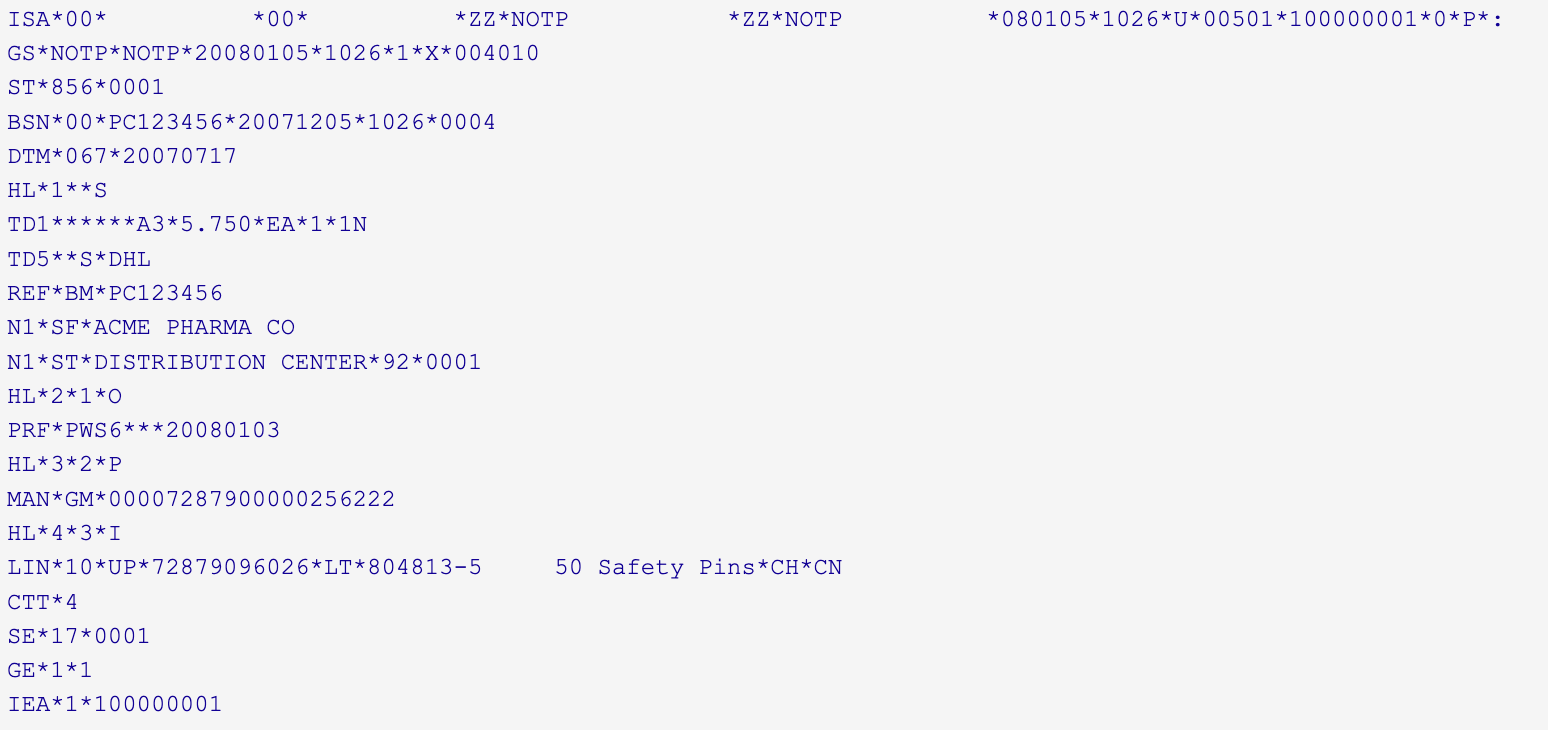 While you can probably make out many of the fields if you take the time to examine them closely, computers have the document processed almost the instant they receive it, thanks to having a full understanding of which EDI standards are being used and what each header and field means.
Types of EDI standards
The power of EDI comes in the standardization, so it's essential that trading partners use the appropriate standards to avoid errors and processing bottlenecks.
- ANSI X12 (X12): Used in the United States for both commercial and non-commercial sectors, with over 300 defined document types.
- UN/EDIFACT: Global standards used by the United Nations for international trade across different sectors.
- ODETTE: EDI standards used for the European automotive industry.
- SWIFT: Standard used in the banking and finance sectors for inter-bank messages and financial transactions using the SWIFT worldwide financial messaging network.
The simplest way for trading partners to communicate is by using the same standard, but this isn't always possible, such as if a US company is a supplier for an automotive company in Europe. However, EDI translation and mapping software still makes it possible for companies to communicate without having to adopt a different EDI standard.
How do businesses turn files into EDI format?
As shown above, EDI files are a seemingly jumbled collection of characters. So does this mean that businesses simply had to adapt and start communicating information in this format?
Fortunately, not.
Instead, the business can continue using their documents internally in whatever format and style they like. How this gets reconciled when exchanging data with trading partners is by the use of an EDI translator.
An EDI translator is a piece of software that translates data from one format into another. Typically, this will be done by creating custom mappings. For instance, if the company uses an invoice with the term "Purchase Order" on it, that Purchase Order field would be mapped to HL21*O and so on, splitting up the documents used internally into components that can be used for EDI document transmission.
Often, these files will be processed and transferred in batches, and then the trading partner's devices will process and translate the files and return a response. Nowadays, EDI is mostly commonly referenced in the context of text files sent via the AS2 protocol, but different businesses may have different file formats and protocol requirements.
Is EDI still relevant today?
Yes, as the original method of electronic data exchange between trading partners, EDI has been effective, and as a result, many companies continue to use it to this day. Some companies, such as Walmart, have invested heavily in the EDI space and require suppliers to use a specific format when working with them, so it's unlikely that EDI will fall out of favor anytime soon.
Over the years, there have been several new technologies that at one time were thought to supplant EDI (including the XML format), but the widespread, entrenched usage of EDI has meant it has continued to remain in use. Although the setup can be complex and the learning curve steep, many businesses find that EDI works as designed, so there hasn't been a massive, widespread push across the board for an updated solution.
However, while the traditional, long-standing EDI methods are still in use, they aren't the only method available for secure, automated B2B document transfers. Many cloud-first businesses have started exploring the use of APIs as a modern alternative. Integrating APIs allows software to quickly communicate and, when needed, get instant feedback and results.
Combined with AI agents, some experts suggest that API can become the new standard for secure B2B document exchange as the differences between usage can be recognized by the agent, while others claim they've heard the same rhetoric for decades and that "there is no need to reinvent the wheel".
Try Couchdrop for b2b and EDI document transfers
Couchdrop is a modern file transfer platform that can be used for secure document exchange, including EDI workflows. The platform includes several tools that can be used for EDI, including working as a cloud AS2 solution where you can build AS2 stations and add trading partners directly in the platform.
You can try Couchdrop free for 14 days with instant access and no credit card required. Sign up now to give it a try, or book a personalized demo today.