A direct-mail marketing firm serving mortgage lenders and financial services companies needed a better way to deliver sensitive customer data to its clients. Using Couchdrop, the firm replaced a repetitive manual file-sharing process with automated workflows that organize files into specific folders with controlled access, generate secure download links, and notify clients when their files are ready.
What file delivery challenges was the firm facing?
The firm specializes in lead generation, data, and direct-mail marketing for mortgage and financial services companies. As part of its operations, it sends weekly mail files to lender clients, typically in ZIP or CSV formats.
These files contain sensitive personal information, making secure delivery an important part of the company's service.
Previously, each delivery required several manual steps. A team member would prepare and compress the file, upload it to a file-sharing service, generate a download link, set a password, and email the link to the appropriate client.
This process had to be repeated for every client, every week. Although it worked, the repetitive administration was becoming inefficient as the firm managed more client deliveries.
At the same time, some banking clients were beginning to request SFTP (Secure File Transfer Protocol) as an alternative way to receive their files. The firm needed a solution that could accommodate different delivery requirements without adding more manual work.
Why did the firm need a different approach?
The challenge wasn't simply finding a secure way to share files. The company already had a process for doing that.
The bigger opportunity was to automate the entire delivery workflow, from receiving a prepared mail file to notifying the correct client that it was ready to download.
Each client needed to receive only its own files, with appropriate access controls to protect sensitive information. The firm also wanted a repeatable process that could be extended to new clients without having to build every workflow from scratch.
Supporting SFTP was another consideration. Rather than managing separate processes for clients requesting different transfer methods, the firm wanted to expand its file delivery capabilities within the same platform.
How did Couchdrop automate client file delivery?
The firm implemented Couchdrop's file automation capabilities to manage the delivery process.
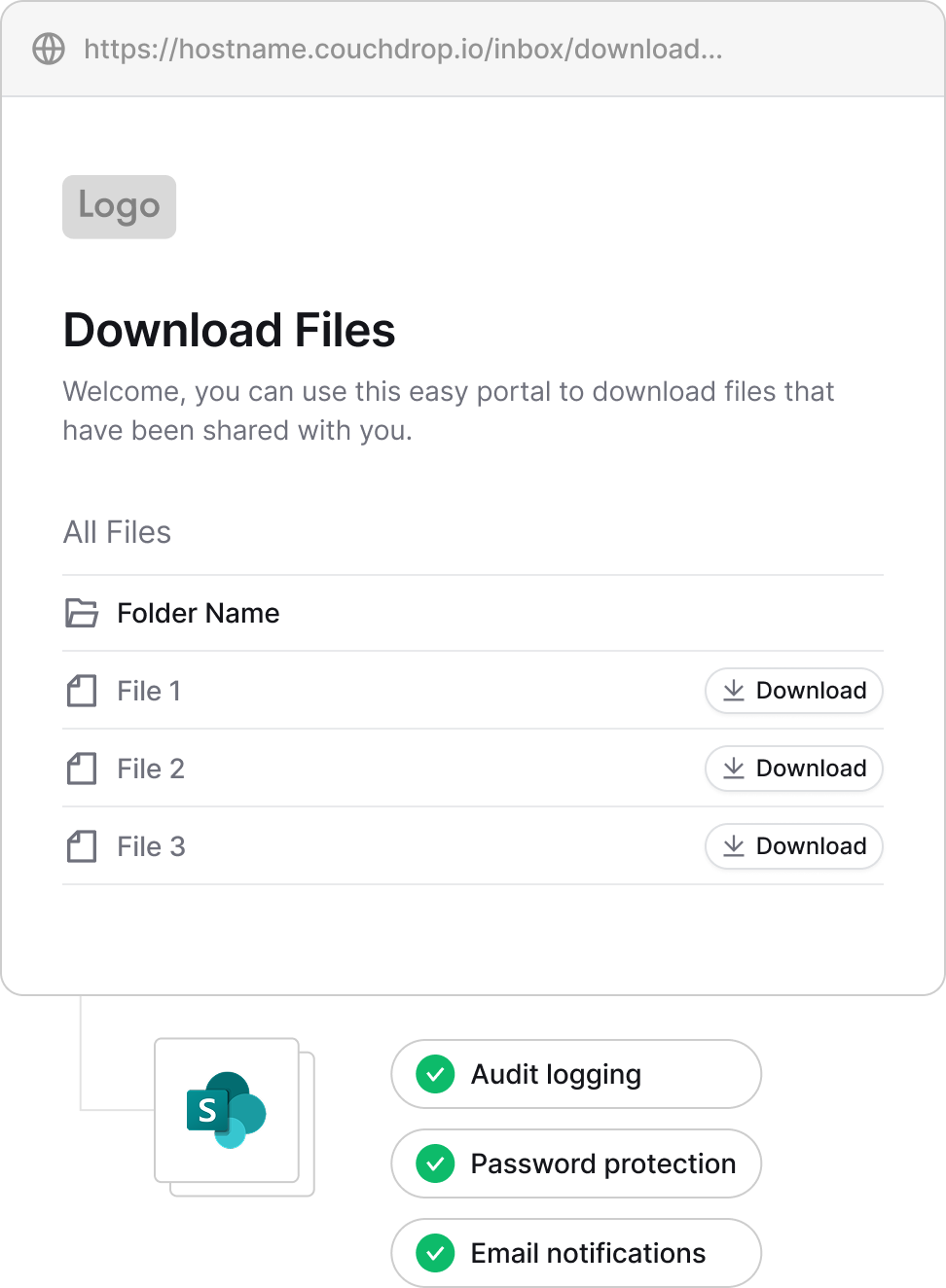
Instead of manually creating and emailing file-sharing links, the team now drops prepared mail files into Couchdrop, where client-specific automations handle the remaining steps.
Each automation uses conditional branches and dynamic file variables to identify which client should receive a particular file. Once a matching file is detected, the workflow moves it into that client's designated folder, generates a secure download link, and emails the link directly to the client.
For example, files prepared for a particular lender can be identified by their file properties and automatically routed to the correct destination without someone having to select the client manually.
Security remains an important part of the process. Download links are password-protected and require email verification, adding another layer of authentication before recipients can access the files.
The firm also made the workflow repeatable. When onboarding a new client, the team can copy an existing automation and update the client-specific settings, rather than configuring every action again.
This allows the company to maintain separate delivery workflows for its clients while reducing the administrative work involved in managing them.
How is the firm expanding secure delivery options?
With its initial client automations operating successfully, the firm upgraded to Couchdrop's Business plan to support its growing requirements.
The expanded plan provides capacity for additional SFTP connections and automations, allowing the firm to accommodate lender clients that prefer to receive files through SFTP rather than secure download links.
It also enables white-labeling, so the firm can present Couchdrop's file-sharing experience using its own company branding.
This gives the business more flexibility in how it delivers files to clients without needing to manage an entirely separate platform for each transfer method.
What improvements has the firm achieved?
The most immediate improvement has been removing the manual steps previously required for every file delivery.
Once a prepared mail file is added to Couchdrop, the appropriate automation handles its routing and delivery notification. Employees no longer need to upload each file individually, create a password-protected link, and send a separate email to the client.
The company has also established a more consistent way to manage sensitive file deliveries. Client-specific folders and protected download links help ensure files are directed to their intended recipients, while email verification provides an additional access control.
Importantly, the process can grow with the business. New client automations can be created by copying and adapting existing workflows, reducing the work required to support additional lenders.
The firm now has active delivery automations for a growing number of clients, with SFTP connections being added as more banking clients request them.
What was previously a series of manual tasks has become a repeatable, automated process for securely delivering sensitive files to financial services clients.