










GoAnywhere and Couchdrop overview
GoAnywhere and Couchdrop are both platforms for securely transferring files, but they take two fundamentally different approaches. GoAnywhere is a traditional enterprise MFT based around on-prem infrastructure, while Couchdrop is a modern, fully SaaS platform for securely sending, receiving, and automating file transfers.
What is GoAnywhere?
Originally developed by Linoma Software in the mid 2000s, GoAnywhere is a managed file transfer platform that is now part of the Fortra suite of products. As one of the original automation and cybersecurity companies, the company has been around for over 50 years (though they became Fortra in 2022).
With its deep history and heritage, Fortra has developed products over decades to meet new requirements that surfaced as digital technologies upgraded and became more widespread. GoAnywhere was an early MFT platform, and at the time of development, there weren't many options for businesses to securely exchange data. At the time, the GoAnywhere platform was extensive and groundbreaking, opening up the possibility for organizations to exchange data and manage everything in one centralized location.
Most companies that had the need for such a product were larger businesses and enterprises who were already invested in infrastructure and would typically have access to on-prem servers for transferring data. These types of businesses are still the core audience for GoAnywhere MFT, and while the platform does now have a cloud offering, the self-hosted version remains their primary focus.
What is Couchdrop?
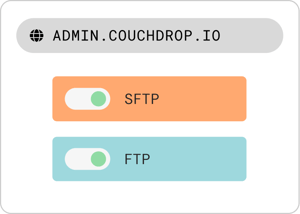
Couchdrop handles SFTP, MFT, EDI, and file automation in one modern platform. Built for the cloud from the beginning, Couchdrop aims to integrate with the platforms that modern businesses rely on, such as cloud storage platforms, databases & analytics systems, data warehouses, and more.
With all of the different platforms and systems that modern organizations need to connect with, managing integrations and transfers can quickly become difficult and complex. Couchdrop aims to be the simplest and most straightforward platform for secure b2b data exchange, with design, management, and updates all based around this idea.
The main way Couchdrop accomplishes this is by removing components that aren't necessary for file exchange, such as managing servers. While there are many cloud file transfer platforms, most are essentially shifting the idea of on-prem systems into the cloud and require setting up software on virtual machines and optimizing job settings. Couchdrop takes a different approach by being cloud-first, taking advantage of all the capabilities of the cloud with no servers, infrastructure, or complex job optimization settings to worry about.
This makes getting started with Couchdrop incredibly simple, and setting up and managing transfers is just as easy.
Infrastructure & Deployment
The file transfer capabilities are an essential component of managed file transfer platforms, but they aren't the only thing that matters. Deployment methods can change how much investment, infrastructure, and IT resources are required, and the infrastructure maintenance requirements can greatly affect system security and the time required to ensure everything is functioning as expected.
GoAnywhere infrastructure and deployment
GoAnywhere is primarily enterprise software, and the focus is on deep integration with systems rather than a streamlined approach to deployment and infrastructure. This means that starting or switching to GoAnywhere takes time, and although the specifics vary depending on requirements, G2 estimates that implementing GoAnywhere typically takes about 2 months to get fully set up.
The time to get set up can change depending on clustering, connections, and compliance testing, but no business is deciding to use GoAnywhere and having it up and running it the next day. (Getting a trial alone typically takes longer than this).
One of the main reasons that GoAnywhere takes time to deploy is because of the infrastructure requirement. Most enterprises need to supply their own file transfer infrastructure and deploy the MFT software on these machines. Then they need to be configured to work together and to scale to meet higher demand, which is done manually through clustering and advanced settings.
Once set up, resources have to be allocated towards managing this infrastructure. Updates and patches are one of the most critical aspects of infrastructure maintenance, and MFT breaches have shown time and time again that these can't be put off. One of the major issues of any MFT that requires manual patching and updates is that it can leave unpatched systems vulnerable to exploits and data breaches, which we'll cover more in the security comparison.
Couchdrop Infrastructure and Deployment
Couchdrop isn't aimed specifically at enterprises and is designed to be simple for any size business to get started and set up.
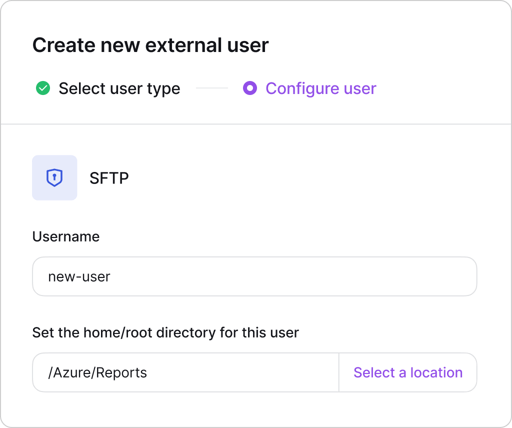
The deployment itself is instant, and Couchdrop is ready to go as soon as you finish the short sign-up form. Connecting storage and adding users is fast as well. Most connections only take a few minutes to configure, and Couchdrop can even autogenerate users to simplify the setup process.
Because Couchdrop is a fully-managed, SaaS platform, there is no ongoing infrastructure to manage. Users don't need to set up, provision, or manage virtual machines, and complex settings like clustering and load balancing are handled automatically in the background. Couchdrop scales to meet demand as needed, without having to worry about machine limitations or adding more licenses.
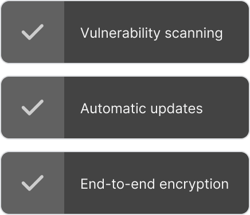
Another benefit of this approach is that updates and patches are applied automatically with no downtime required. This also allows data to be actively protected with continuous monitoring, automated threat response, and independent security testing across the infrastructure.
Platform integrations
As most organizations now use the cloud in some capacity--especially cloud storage platforms--a managed file transfer platform that integrates with these platforms is becoming more and more of a priority. Both the extent of integrations and the ease of adding connectors are important factors for integrating the MFT into business operations.
GoAnywhere platform integrations
GoAnywhere has a large collection of integrations, but the catch is that they're part of an add-on that uses their Cloud Connectors marketplace. So while you can connect to multiple cloud storage providers like Amazon, Google, and Microsoft--as well as business applications like Salesforce--they aren't part of the base package.
For Enterprises that are more concerned with connectivity than cost, GoAnywhere has plenty of integrations to work with. They have connectors for most major storage platforms, but most of these have multiple steps to connect, such as creating applications and authorizing GoAnywhere to connect to the application. They also have custom connector development options available, though these require technical expertise to implement.
Couchdrop platform integrations
Couchdrop was designed for the cloud, and that would be meaningless if it couldn't integrate with popular cloud platforms. In fact, these integrations have been one of the primary reasons businesses have chosen Couchdrop since the beginning. Now, Couchdrop can integrate with over 50 cloud platforms, including over 30 storage options that encompass cloud storage, on-prem servers, and remote FTP/SFTP servers.
Connecting storage is incredibly fast and simple. Most of them only take seconds to integrate and use OAUth to connect. This includes SharePoint, Google Drive, and Dropbox, and Couchdrop also integrates with block storage like Amazon S3, Azure Blob Storage, and Backblaze B2.
Another key benefit of Couchdrop is how it integrates with these storage platforms. Most MFTs, including GoAnywhere, store files in a temporary storage layer before moving them to the destination. Not Couchdrop. Files are streamed directly between platforms and are never stored by Couchdrop at any point.
Along with storage platforms, Couchdrop can also integrate with analytics engines, message queues, cloud databases, iPaaS, and can send events to SIEMs. Modern businesses that are already working with cloud systems can integrate with the systems they rely on, while hybrid organizations can connect their on-prem and cloud systems using one simple platform.
Automation capabilities
Automations is where many businesses see the most day-to-day value from their MFT solution. After creating the automations, they can basically run on their own, saving time and resources while reducing the likelihood of errors.
GoAnywhere automation capabilities
GoAnywhere has extensive automation capabilities through their workflow engine. Through this workflow engine, you can create multi-step workflows, set up folder monitoring, configure event triggers, and access functionality through the command line and API.
While powerful, these features require technical investment for setup and configuration. The setup isn't intuitive for a typical user, which means organizations need to dedicate resources and people to build and maintain the workflows. The sheer number of options and required components that need to be configured can also be time-consuming and overwhelming, and many users on G2 report that it has a steep learning curve, especially for users who don't have previous experience with automation in MFTs.
Couchdrop automation capabilities
Couchdrop also has a wide range of automation options, while keeping the core focus on simplicity and accessibility. With Couchdrop, you can build multi-step flows, schedule jobs, run looped actions, transform files, push files to cloud systems, and more, all without having to write a line of code.
Automations are set up in a visual builder with clear processing actions (also indicated by letters and numbers), so it's easy to see at a glance what the automation is doing. Triggers can be based on events (such as an external user uploading via SFTP), or transfers from external parties can be scheduled to happen at regular intervals.
To make automations even more accessible to non-technical users, Couchdrop offers a flow builder and shared actions. The flow builder is a simple, visual way to create FTP/SFTP users or to set up basic transfers from partners, while shared actions allow a user to simply choose a file to run an action on, and everything will happen in the background. For instance, the user could simply choose "Send file to Partner A" and actions to encrypt, rename, and send the file to that partner happen behind the scenes without the user needing to know the specifics.
Security & Compliance
The "secure" in secure file transfer, these components are becoming more and more important as businesses recognize all of the different ways that data can be compromised. Along with the obvious threat of cyberattacks, there are also risks for data loss through oversharing or providing legitimate third-party applications (including MFTs) more access than they need.
GoAnywhere Security & Compliance
GoAnywhere offers comprehensive enterprise security features with highly customizable options. This includes detailed audit logging and reporting, role-based authentication methods, and Active Directory/LDAP integration. DLP is available through an add-on product.
The platform also meets many security compliance frameworks. They specifically mention that they can meet GDPR, GLBA, PCI DSS, SOX, and HIPAA & HITECH compliance. Fortra also mentions that they can meet industry and location-specific standards like PDPA in Singapore and PIPEDA in Canada.
However, there is a glaring issue with all MFTs that require manual patching and updates: they can leave an organization's data open for exploits and breaches. In fact, there have been a number of high-profile security breaches in MFT platforms in the last few years, amounting to billions of dollars in losses. The reason these continue to be damaging is because even when a fix is released, that patch still has to be applied, which can require downtime. Regressions in the update can also break custom integrations, workflows, clustering, and require significant resources to remedy.
As a result, many on-prem systems remain unpatched and at risk of being breached by known vulnerabilities if the right conditions present themselves.
Couchdrop Security & Compliance
Couchdrop employs end-to-end encryption in all transfers and takes a modern approach to security with built-in enterprise features available to all users. This includes Azure AD and SAML integration, global firewall controls, multi-factor authentication, comprehensive audit logging, and more. Data Loss Protection features are also available to use through Transfer Shield.
Along with the configurable security controls, Couchdrop is SOC 2 certified and has a separate, dedicated infrastructure for HIPAA file transfers where all data processing activities stay within the United States. Couchdrop is also suitable for GDPR and industry-specific compliance frameworks thanks to its secure cloud infrastructure.
The cloud infrastructure is also continuously monitored for threats and anomalies, reducing the likelihood of attackers breaking through. The containerization architecture allows infrastructure components to be isolated and updated independently, while systems can be rapidly replaced if compromised without single points of failure.
One unique aspect of Couchdrop compared to other MFTs is the lack of a temporary storage layer. Unlike other file transfer platforms, Couchdrop never stores user files at any point. Instead, files are "streamed" directly between platforms for an added level of security.
As a SaaS platform, Couchdrop requires no patching or manual updating. Security and performance updates are delivered automatically with no downtime required. This significantly increased platform security by limiting one of the primary attack vectors: unpatched vulnerabilities. The burden is taken off of the organization entirely, with Couchdrop keeping the platform secure and up-to-date for all users.
Pricing structure
GoAnywhere pricing structure and trials
GoAnywhere uses a traditional sales cycle where you request interest, have someone review your request, then they provision it and you can run a trial before having to pay for the license.
For the on-prem version, you'll need to download and install the software. There are no limitations on use, but it's time-restricted to 30 days.
Their MFTaaS version doesn't have a default trial, although there is a page on the website explaining that it is possible to get one by requesting a trial the same way and completing an additional form for GoAnywhere Cloud Hosted. There are also some reports of being able to get a trial by requesting one on a demo call, and there is a free interactive demo available to try.
After going through the trial, you'll need to purchase services or bundles to activate the full version. Pricing is based primarily on the number of licenses required, and maintenance and support contracts are annual commitments.
Couchdrop pricing structure and trials
As Couchdrop was designed to be simple and easy to use, getting a demo is a supplemental option instead of a requirement. Organizations that have complex transfer or compliance requirements typically request a demo as part of the testing process. Demos can be self-scheduled on the book a demo page with availability in all time zones.
Many users sign up and try the full platform using the free 14-day trial, which gives instant access to Couchdrop with no credit card required.
From there, you can sign up for a plan directly in the platform and keep your setup and settings. All plans are month-to-month with no lock-in so you can cancel or change plans at any time, and support and updates are included in all plans.
Product Support and User Experience
GoAnywhere product support and user experience
Most GoAnywhere users are generally satisfied with the product and support that they receive. Support for critical issues is available 24/7 with multiple ways to get in touch, including submitting a ticket, email, phone, and chat.
However, this level of support and maintenance isn't included in the base package and requires a separate subscription. As one customer noted on G2: "In my experience the lines are blurred when it comes to support. Project assistance is not covered under normal support. There are occasional errors that we have needed to resolve on our own, which is time consuming."
On G2, GoAnywhere MFT is rated 4.6 out of 5 stars. Users are happy with the integrations, automations, and general performance, at least once they have it set up and running. Two issues are often cited with the product: complexity and a dated interface. Users note a steep learning curve and a long setup time, which is exacerbated by the interface.
While the team has mentioned that there are plans to address these issues with an improved interface and AI assistant, these have yet to be released.
Couchdrop product support and user experience
Users are almost always extremely satisfied with Couchdrop, and the reviews back that up. On G2, Couchdrop scores an impressive 4.9 out of 5 stars. Simplicity, integrations, and security are often mentioned as strong points, as well as the experience with the support team.
There are multiple ways to get in touch for support, and you'll always work directly with a technical expert. Support is never outsourced, and there are no tiered levels. Premium Support isn't any different in terms of quality, but instead has a faster guaranteed response time. Support is always praised as a highlight from Couchdrop.
In fact, Couchdrop has consistently won awards for Best Support and Easiest to Do Business With for the last several years. Users love that getting started and set up is simple without any obstacles, and that they have several ways to get directly in touch with a product expert if they need assistance.
Couchdrop vs GoAnywhere: which is right for you?
Both Couchdrop and GoAnywhere are highly rated file transfer platforms that can handle secure file transfers for a variety of organizations. The best fit for your organization depends on the specific focuses and if you require on-prem infrastructure.
GoAnywhere is a good choice for organizations that:
- Have a strict on-premise mandate and require their own file transfer infrastructure
- Need complex, multi-step, specialized automations
- Require deep, highly-specific, customized integrations
- Already have a dedicated team of file transfer professionals who can manage complex software
Couchdrop is a good fit for businesses that:
- Prefer a simple, secure, modern platform accessible by anyone
- Require security and performance but don't want to manage infrastructure
- Need to transfer files between cloud systems and storage
- Favor a simple, visual automation builder over a highly complex workflow builder
- Like the flexibility of month-to-month pricing with no lock-in
- Want additional data protections with no temporary storage layer and automatic updates
While platform comparisons are helpful, we think the best way to determine which platform is better is to experience them for yourself. And with Couchdrop, starting a trial is incredibly easy. Simply register for an account to try Couchdrop free for 14 days with no credit card required.
If you have an advanced use case or simply want to get an overview of the platform, we're happy to talk with you to see if Couchdrop is the right fit for your business. To set up a call with us, you can book a demo now.